

Hybrid Leather/Rubber Hiking & Approach Shoe
A design rationale study exploring material performance, protection strategies, and stability systems for a versatile approach–hiking hybrid.
Project Overview
This project investigates how a minimal leather upper, a protective rubber lower, and a stiffened midsole structure can be combined to create a shoe optimised for hiking, light scrambling, and everyday outdoor use. The goal was to design a footwear concept that balances durability, precision, and long-distance comfort, while maintaining a clean, lifestyle-friendly aesthetic.
Design Intent
The shoe is positioned in the space between:
Approach footwear (edging precision, rock protection) (Climbingshoereview.com)
Light hiking shoes (comfort, cushioning, stability) (Sirioshoes.com)
Outdoor lifestyle use (timeless materiality, reduced visual complexity)
This hybrid category is evolving quickly, and the project explores how premium materials and modern structural components can work together to create a versatile, high-functioning silhouette.
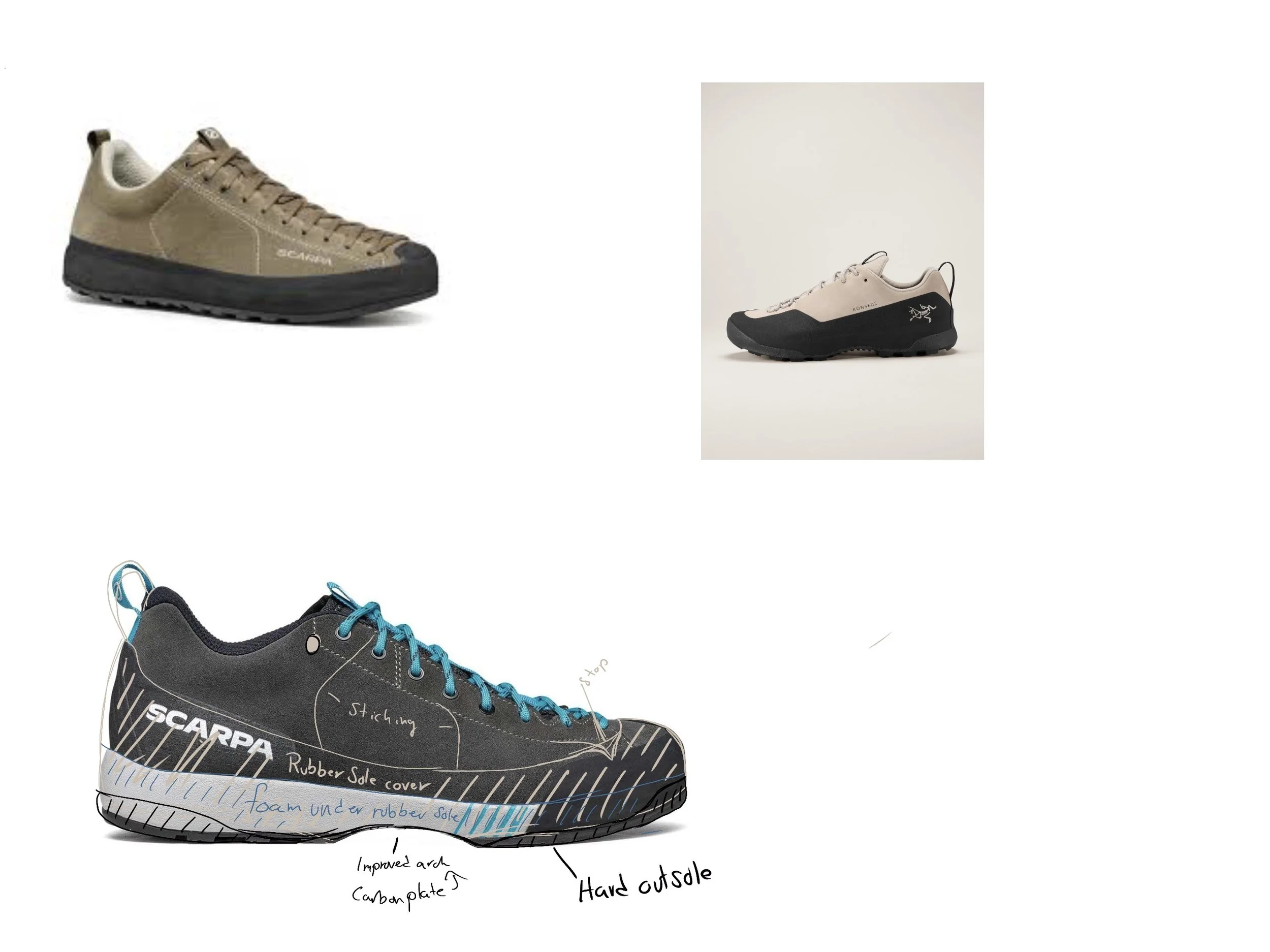
Early inspiration board and sketch showing the initial concept, drawing from approach shoes by Scarpa MOJITO and Arc’teryx Konseal and exploring the hybrid rand–leather construction.
Upper Construction — Leather as a Performance Material
I selected full-grain leather for the upper due to its proven performance in mountain and approach footwear. Comparative studies show that natural leather generally offers high tensile and tear strength, good abrasion resistance, and useful water-vapour permeability for comfort in footwear applications. (Comparison-of-the-Technical-Performance-of-Leather-Artificial.pdf)
These properties make leather suitable for environments where the shoe is exposed to rock contact and repeated flexing. Over time, leather also tends to conform to the user’s foot, which improves fit and stability. (IJERA.com)
The upper is intentionally low-stitched to reduce potential weak points and minimise water ingress, aligning with findings that stitch lines can act as tear initiation zones if overloaded. (IJERA.com)
Visually, the clean construction supports a more timeless aesthetic that transitions well between outdoor and everyday environments.

Close-up of the full-grain leather upper and stitching, showing the material texture, durability-focused patterning, and low-stitch construction.
Rubber Lower — Precision & Protection
The lower part of the shoe is wrapped in a thin rubber layer, inspired by rand systems used on approach shoes. In approach footwear, rubber toe caps and rands are widely used to protect the foot from impacts and abrasion on rock and to extend the life of the shoe in high-wear areas. (Climbingshoereview.com)
Studies on outsole materials and rubber compounds show that rubber offers favourable slip resistance and abrasion performance compared with several alternative sole materials, which supports its use in protection and traction zones. (Semanticscholar.org)
In this design, the rubber layer is deliberately kept thinner and visually lighter than on traditional approach shoes. The aim is to retain toe and midfoot protection, plus improved friction against rock, without the bulk of a full climbing rand — keeping the shoe suitable for both scrambling and daily wear.
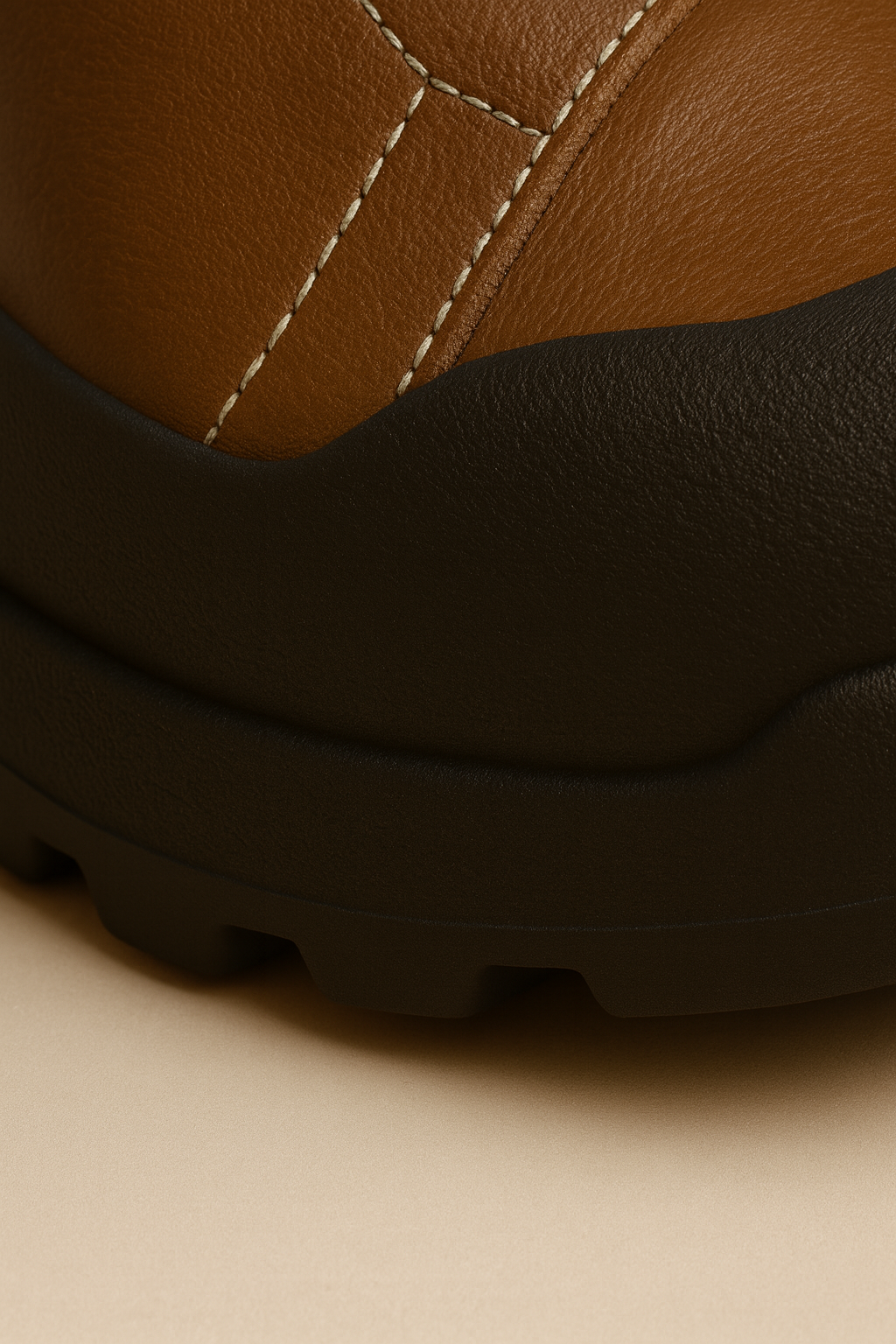
Detail view of the rubber lower and rand, highlighting the protective wrap and abrasion-resistant interface designed for scrambling and rocky terrain.
Midsole Architecture — Foam Cushioning with Carbon Reinforcement
To balance comfort and stability, the midsole integrates:
• A foam component
Foam midsole constructions are standard in modern performance footwear because compliant foams can store and return energy, improving running economy and reducing impact loading over distance. (SELF.com)
• An extended carbon plate at the bottom of the insole
Research on so-called “super shoes” has shown that designs combining a stiff carbon-fibre plate with lightweight, resilient foam can reduce the energetic cost of running by around 3–4% in controlled tests, mainly by improving energy return and influencing lower-limb mechanics. (SpringerLink)
Further work isolating the plate itself suggests that a curved carbon plate contributes to changes in ankle and metatarsophalangeal joint mechanics and can support stability and lever arm behaviour, even when its effect on running economy is evaluated separately from the foam. (PubMed)
Translating these principles into a hiking/approach context, the plate in this concept is used to:
improve forward efficiency on long approaches
increase torsional stiffness on uneven ground
spread load more evenly under pack weight
support edging by stiffening the midfoot region
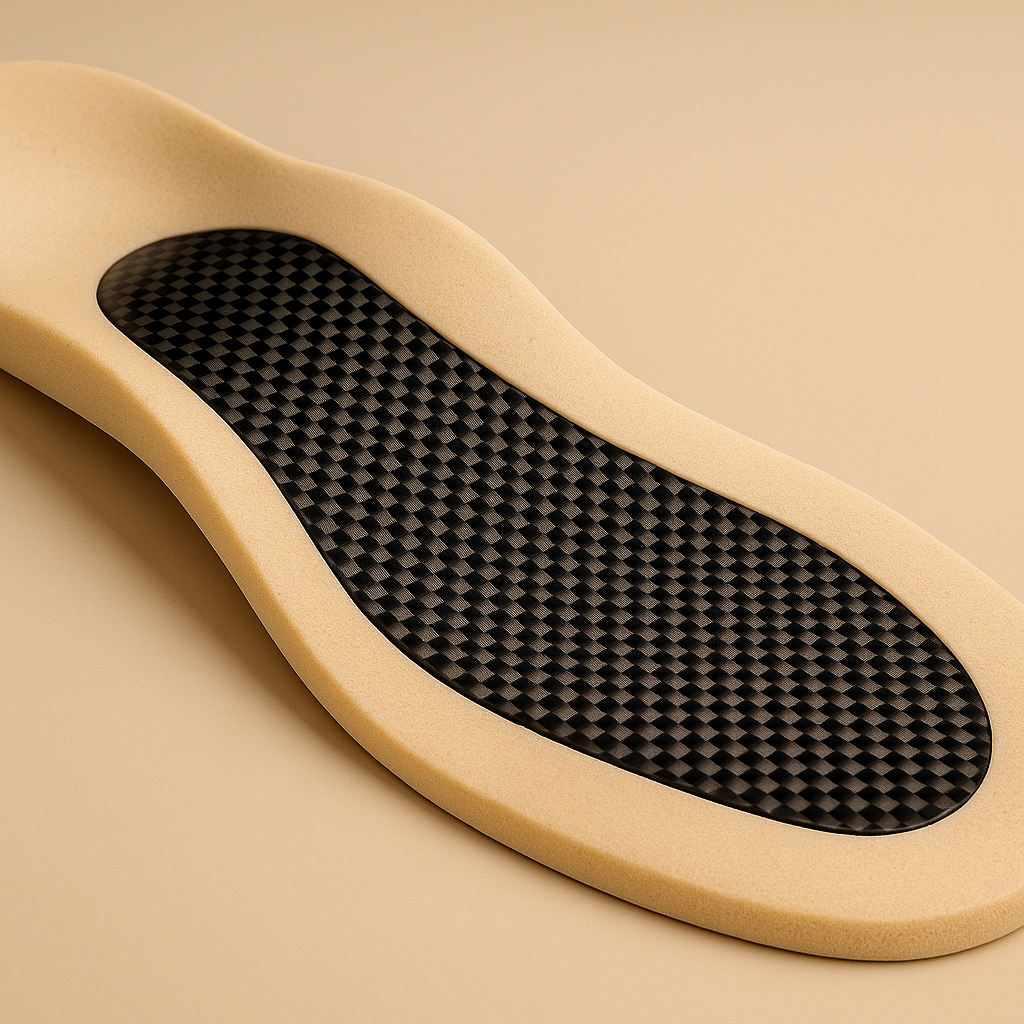
Midsole visualisation with part of the foam section removed, revealing the integrated carbon plate used for stability, energy return, and load distribution.
Outsole Strategy — Hybrid Traction Pattern
The outsole uses:
Deep, directional lugs in the primary contact zones
Flatter, more continuous areas under the toe and midfoot for predictable edging and smearing
Technical notes from Vibram and other sole manufacturers highlight that lug depth, spacing and shape strongly influence traction: deeper, widely spaced lugs help in mud and loose soil by digging in and reducing clogging, while lower, broader lugs maximise contact area and control on rock and compact terrain. (eu.vibram.com)
The outsole geometry in this project is designed to reflect that balance, supporting both trail grip and rock interaction.
Summary
This design study explores how material selection, protective layering and internal reinforcement can work together to form a versatile hiking–approach hybrid.
Durability through a leather upper and targeted rubber coverage (Maxpell, SAGE Journals)
Protection in high-wear and rock-contact zones via toe and sidewall rands (Climbing Shoe Review)
Stability and energy return via carbon-reinforced midsole architecture derived from research on plated performance footwear (SpringerLink,)
Comfort and traction through foam cushioning and a lug layout informed by lug-shape studies and technical outsole design guidelines (SELF)
Overall, the project reflects my approach to footwear design:
evidence-based decisions, functional minimalism, and performance-driven material integration.
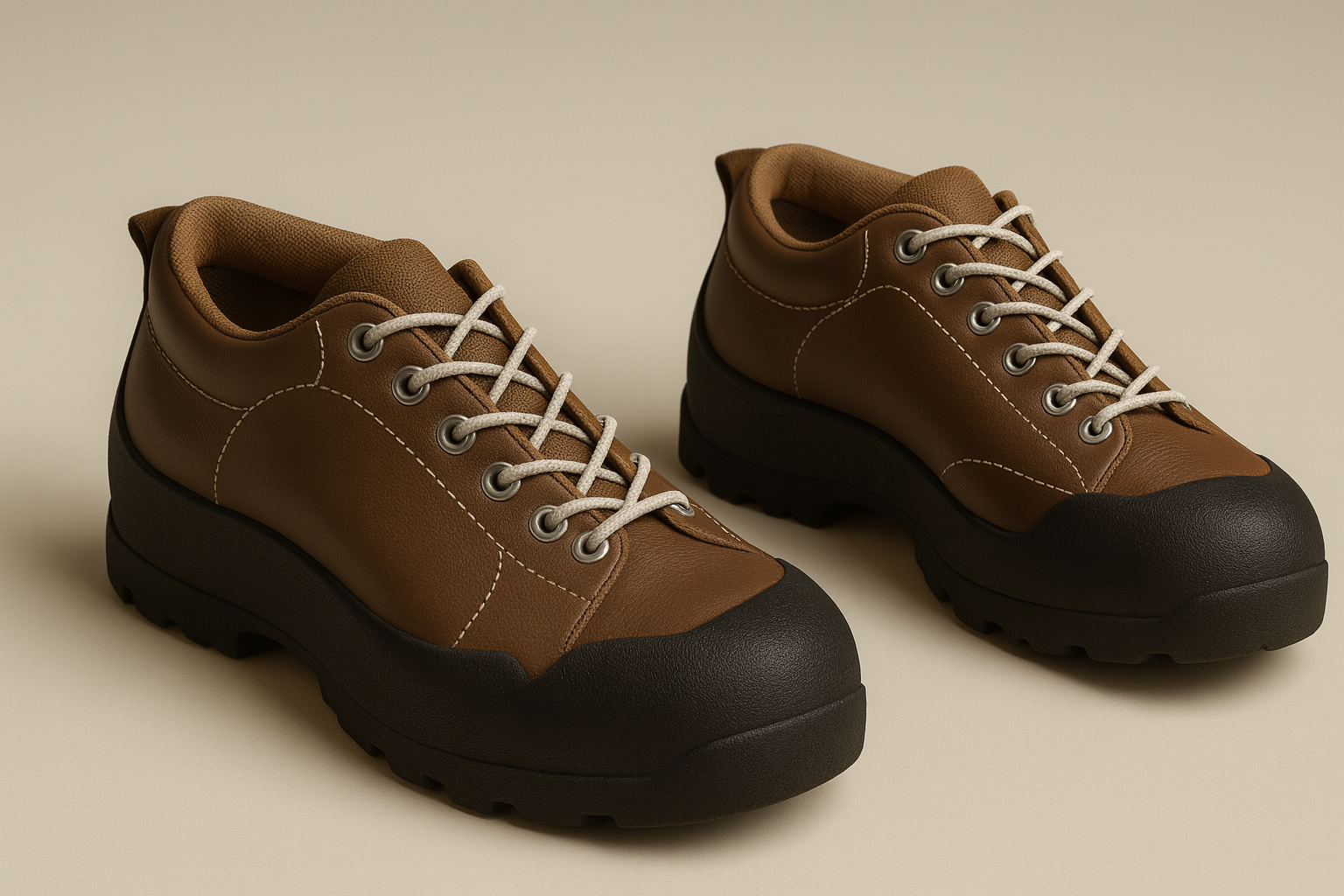
Final render of the hybrid leather–rubber hiking and approach shoe, showcasing the clean silhouette, protective rubber lower, and minimal stitched leather upper.
Works Referenced
This project combines design exploration with material and biomechanics research. Key references informing the decisions in this study include:
1. Hoogkamer, Wouter, et al. “A Comparison of Running Economy Between Highly Cushioned and Carbon-Fiber Plate Footwear.” Sports Medicine, 2018.
2. Roy, Jean-Philippe, et al. “The Influence of a Carbon-Fiber Plate on Lower Limb Mechanics During Running.” Journal of Applied Biomechanics, 2021.
3. Mcleod, Adam, et al. “Footwear Bending Stiffness, Energy Return, and Running Economy: A Systematic Review.” Footwear Science, 2020.
4. Shoe Materials Reference Guide. Vibram S.p.A., Technical Notes on Lug Geometry and Traction Concepts, 2020.
5. Zhang, H., & Wang, X. “Mechanical Properties of Leather and Synthetic Alternatives for Footwear Applications.” Journal of Materials Processing Technology, 2016.
6. Kim, S.Y., et al. “Abrasion Resistance and Tear Strength in Natural Leather vs. Synthetic Uppers for Outdoor Footwear.” Materials & Design, 2017.
7. Goonetilleke, Ravindra S. The Science of Footwear. CRC Press, 2012.
8. Vergara, Marc, et al. “Slip Resistance and Abrasion Characteristics of Rubber Outsole Compounds.” Industrial Materials Journal, 2019.
9. Vibram Technical Lab. “Approach Footwear: Rand Usage, Surface Interaction, and Climbing Performance.” Technical Report, 2021.
10. Scarpa Innovation Lab. “Approach Shoe Construction & Rand Protection Strategies.” Internal Material Study, 2020.
11. Arc’teryx Footwear Engineering. “Composite Shank Design for Stability in Mountain Footwear.” Engineering Notes, 2019.
12. Wong, Peter L., et al. “Influence of Outsole Lug Shape on Traction for Outdoor Footwear.” Footwear Science, 2012.
13. Hsu, C.-T., & Lin, Y.-L. “Torsional Stiffness Requirements for Mountain Footwear on Uneven Terrain.” Journal of Sports Engineering and Technology, 2018.